NAFTA-related job losses have piled up since
1993
Since the North American Free Trade Agreement (NAFTA) was signed in 1993,
the rise in the U.S. trade deficit with Canada and Mexico through 2002
caused the displacement of production that supported 879,280 U.S. jobs.
NAFTA is a free trade and investment agreement that provided investors
with a unique set of guarantees designed to stimulate foreign direct
investment in Mexico and Canada. It has facilitated the movement of
factories from the United States to Canada and Mexico. Most of these jobs
were high-wage positions in manufacturing industries.
Proponents of new trade agreements that build on NAFTA, such as the
proposed Free Trade Agreement of the Americas (FTAA), have frequently
claimed that such deals create jobs and raise incomes in the United
States. These claims are based only on the positive effects of exports
(known as "export effects"), ignoring the negative effects of imports
(known as "import effects"). Such arguments are an attempt to hide the
costs of new trade deals in order to boost the reported benefits.
The problem with these claims is that they misrepresent the real effects
of trade on the U.S. economy: trade both creates and destroys jobs.
Increases in U.S. exports tend to create jobs in this country, but
increases in imports tend to reduce jobs by displacing goods that
otherwise would have been made in the United States by domestic workers.
Ignoring imports and counting only exports is like balancing a checkbook
by counting only deposits but not withdrawals.
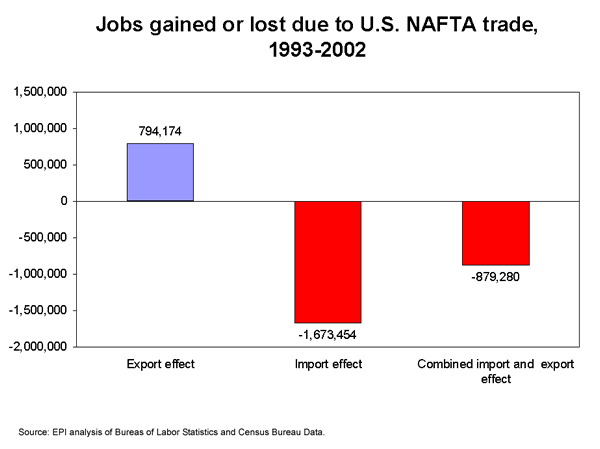
Between 1993 and 2002, NAFTA resulted in an increase in exports that
created 794,194 jobs, but it displaced production that would have
supported 1,673,454 jobs (see figure). Thus, the combined effect of
changes in imports and exports as a result of NAFTA was a loss of 879,280
U.S. jobs. These NAFTA-related job losses suggest that U.S. workers have
good reason to be concerned that the proposed Free Trade Agreement of the
Americas will threaten jobs and communities.
.
«Back