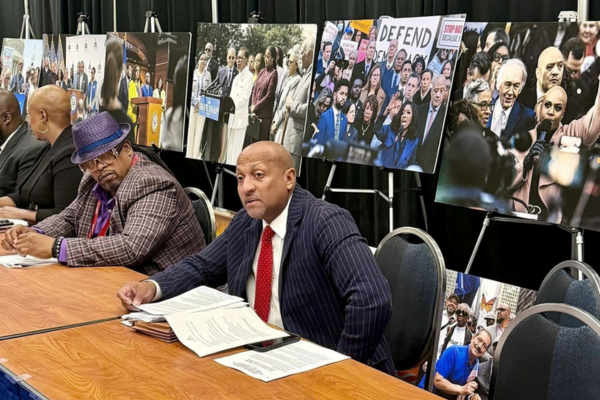



IAM National Legislative and Political Director Hasan Solomon recently participated in a strategic planning session with the Congressional Black Caucus (CBC) focused on Black workers and the labor movement’s legislative priorities heading into the 120th Congress. The meeting was chaired by Vince Evans, Executive Director of the Congressional Black Caucus.
The meeting, held at the Walter E. Washington Convention Center in D.C., brought together representatives from IAM and other labor unions, community allies including the American Federation of Government Employees (AFGE), the American Postal Workers Union (APWU), the National Education Association (NEA), AFT Union, United Mine Workers of America, International Union of Painters and Allied Trades (IUPAT), SAG-AFTRA, and many more.
Solomon presented on the labor movement’s top priorities. We also heard directly from AFGE President Everett Kelley, NEA President Princess R. Moss, and APWU President Jonathan Smith on how to strengthen the partnership with the Congressional Black Caucus.
Rep. Ayanna Pressley (D-Mass.) spoke on the importance of fighting for working families and highlighted the urgent unemployment crisis facing Black Women in our nation. In a recent Newsweek Op-ed written by AFL-CIO National Secretary Fred Redmond, he pointed out that Black unemployment climbed to 6.9% in 2025, and for Black women, it jumped to 6.7%.
Also in attendance were Florida State Representative and Florida U.S. Senate candidate Angie Nixon (D), Emeritus Executive Vice President of the National AFL-CIO Arlene Holt Baker, and Joy Reid, host of “The Joy Reid Show.”
The panel session focused on five guiding questions: where the labor movement and Black communities stand today; which affirmative policies the CBC should be ready to advance; what partners can do together; and what commitments should follow.
The panel closed with a discussion of challenges and opportunities facing Black workers, what resources, including research, organizing, communications, and coalition-building, will be needed to carry that agenda forward, and how CBC members, unions, and other partners can continue working together.