


Wildfires continue to exact a growing toll on communities across the United States. According to NOAA data, wildfire damage has averaged between $15 billion and $25 billion annually over the past two decades. In 2025 alone, wildfire losses reached an estimated $57 billion. So far in 2026, more than 3.3 million acres have burned, with many fires sparked by lightning strikes on public lands and in national forests.
The dangers facing wildland firefighters were brought into sharp focus on June 27, when three firefighters were killed and two others suffered critical injuries while battling the Knowles Fire in western Colorado. The fire later merged with another blaze and is now known as the Snyder Fire.
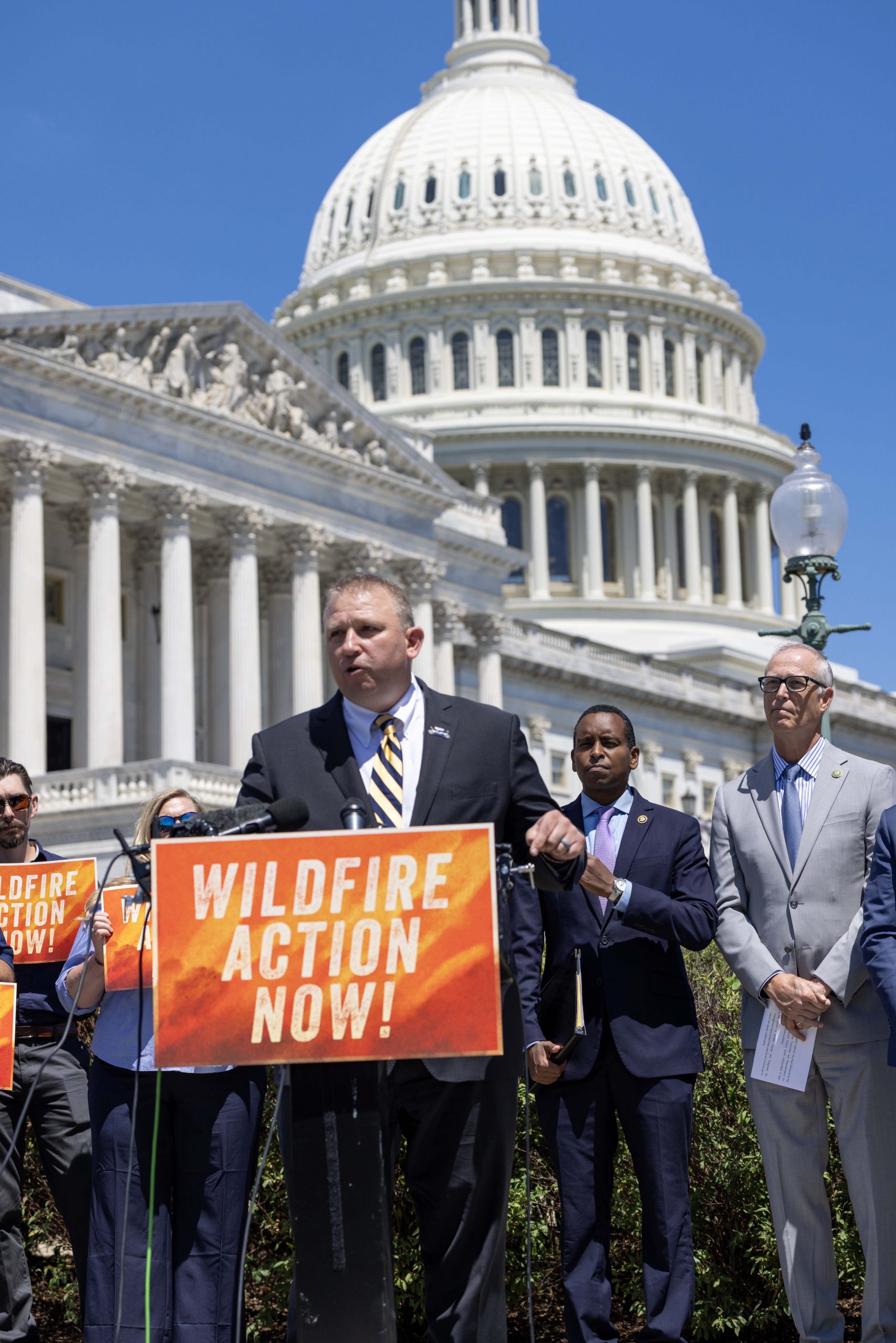
Just days before the tragedy, members of Congress joined members of the National Federation of Federal Employees (NFFE-IAM) outside the U.S. Capitol to warn that staffing reductions, budget cuts, and agency reorganization efforts are weakening the federal government’s ability to prevent and respond to increasingly severe wildfires.
“Key wildfire prevention, mitigation, and management programs are experiencing irresponsible and reckless staffing and budget cuts that have dramatically, in my view, worsened working conditions for our wildland firefighters,” said U.S. Rep. Joe Neguse (D-Colo.). “This is creating unsustainable workloads, inadequate pay and benefits, and a dwindling trust in agency leadership, leading to three out of four wildland firefighters at the federal level considering leaving the workforce.”
In March 2026, the Trump administration reduced the U.S. Forest Service budget by $438 million, a 24% cut. The administration also announced plans to reorganize the agency into a state-based model, reducing regional staffing and relocating the agency’s headquarters from Washington, D.C., to Salt Lake City.
“In reality, this is a dismantling of a beloved 120-year institution that maintains the American people’s public lands,” said NFFE-IAM National President Randy Erwin. “It would close 57 research facilities in 31 states, dismantling decades of locally based science that cannot be replaced. Once that research is disrupted, the taxpayer investment made over decades is lost forever.”
The reorganization proposal would also create a new Wildland Fire Service, replacing the Forest Service’s long-established wildfire response structure. The Forest Service’s incident management system has become the national standard for emergency and disaster response and has been adopted by emergency services around the world.
NFFE-IAM leaders argue that the proposed changes come at a particularly dangerous time. Fire activity in 2026 is already running at roughly twice the pace of the 10-year average, increasing concerns about the nation’s preparedness for a worsening wildfire season.
Federal workforce reductions have further compounded those concerns. Since 2025, thousands of Forest Service employees have left the agency through layoffs, attrition, and workforce restructuring efforts.
“Through these actions, we have already seen the loss of approximately 5,800 employees,” said Genny Kotyk, president of the NFFE-IAM Forest Service Council. “An additional 6,500 employees could be forced to relocate, resign, or accept significantly different positions. Our union surveyed employees and found that 93% would not relocate if forced to make that choice.
“This could be devastating for our country and the people who depend on these public lands,” Kotyk continued. “At a time when fire season is burning at twice the rate of the 10-year average, these cuts ignore our responsibilities to provide sustainable timber resources, protect endangered species, preserve archaeological sites, uphold tribal agreements, and keep our communities safe.”
As wildfire risks continue to grow, NFFE-IAM members and their allies are calling on Congress to protect the staffing, research, and operational resources needed to safeguard public lands, support frontline firefighters, and strengthen the nation’s wildfire response capabilities.