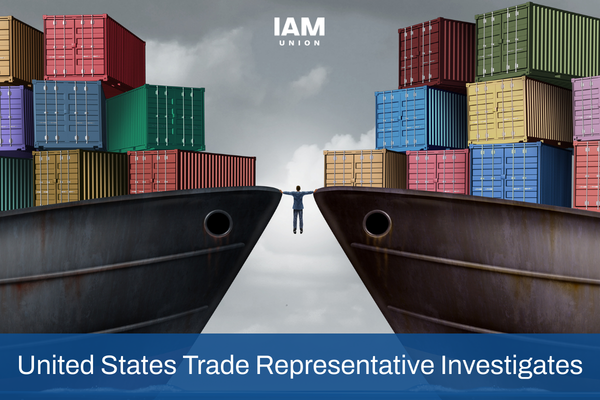


The IAM Union (International Association of Machinists and Aerospace Workers) is welcoming sweeping new investigations launched by the Office of the United States Trade Representative aimed at confronting global industrial overcapacity and the continued use of forced labor in international supply chains.
The investigations, announced by U.S. Trade Representative Jamieson Greer, include 60 separate probes under Section 301 of the Trade Act of 1974 into whether major trading partners have failed to take action against the importation of goods produced with forced labor.
“For decades, unfair trade practices and government-backed overproduction overseas have put American workers at a disadvantage,” said IAM Union International President Brian Bryant. “Workers in aerospace, defense, shipbuilding, and manufacturing should never have to compete with systems built on subsidies, weak labor protections, or forced labor.”
The investigations will examine whether countries’ policies or enforcement failures allow forced labor to remain embedded in global supply chains.
Forced labor is defined as work or service extracted from a person under threat of penalty and performed involuntarily. U.S. law has prohibited the importation of goods produced with forced labor for nearly a century, and international labor standards similarly recognize forced labor as a serious human rights violation.
Despite these longstanding prohibitions, the practice continues worldwide. According to the International Labour Organization, an estimated 28 million people globally were trapped in forced labor as of 2021, an increase of 2.7 million since 2016.
Companies that rely on forced labor gain an unfair advantage by dramatically lowering labor costs, allowing them to sell goods at artificially low prices that undercut responsible employers and threaten good jobs in the United States.
The forced labor investigations target 60 major U.S. trading partners, collectively accounting for more than 99% of U.S. imports in 2024.
Among the economies subject to investigation are China, South Korea, Canada, India, Japan, Mexico, Vietnam, and members of the European Union, among many others.
While some countries have adopted measures intended to restrict goods made with forced labor, USTR officials say none of the economies under investigation appear to have both adopted and effectively enforced comprehensive bans on those imports.
Under Section 301 procedures, the United States will seek consultations with the governments involved while also gathering public input. USTR has invited public comments by April 15 and plans to begin public hearings on the investigations starting April 28.
In addition to forced labor, USTR is also examining global industrial overcapacity particularly in sectors such as steel and aluminum, where government subsidies and state-directed production have distorted global markets.
Countries such as China have long been criticized for producing far more steel than domestic demand requires, flooding international markets and driving down prices for manufacturers worldwide. Similar concerns have been raised about excess production in South Korea and other exporting nations.
IAM leaders say addressing these practices is essential to protecting American manufacturing jobs and rebuilding a fair global trading system.
The broader labor movement is also backing the investigations. The AFL-CIO praised the action as a necessary step to protect workers and enforce labor rights globally.
“For decades, countries have flooded global industrial markets in an effort to tilt the trade balance in their favor and undermine domestic producers at the expense of union workers and their jobs,” the federation said in a statement. “The fact that forced labor continues in global supply chains violates human dignity and labor rights while harming workers and manufacturers who refuse to participate in this exploitation.”
IAM Union leaders say confronting forced labor and global overcapacity is critical to ensuring American workers can compete on fair terms.
“American workers can compete with anyone in the world when the rules are fair,” said Bryant. “Trade enforcement that protects workers’ rights and stops unfair practices is essential to defending good-paying jobs and rebuilding U.S. manufacturing.”
The IAM Union (International Association of Machinists and Aerospace Workers) represents approximately 600,000 active and retired members in aerospace, defense, airlines, shipbuilding, rail, transit, healthcare, automotive, and other industries across North America.